
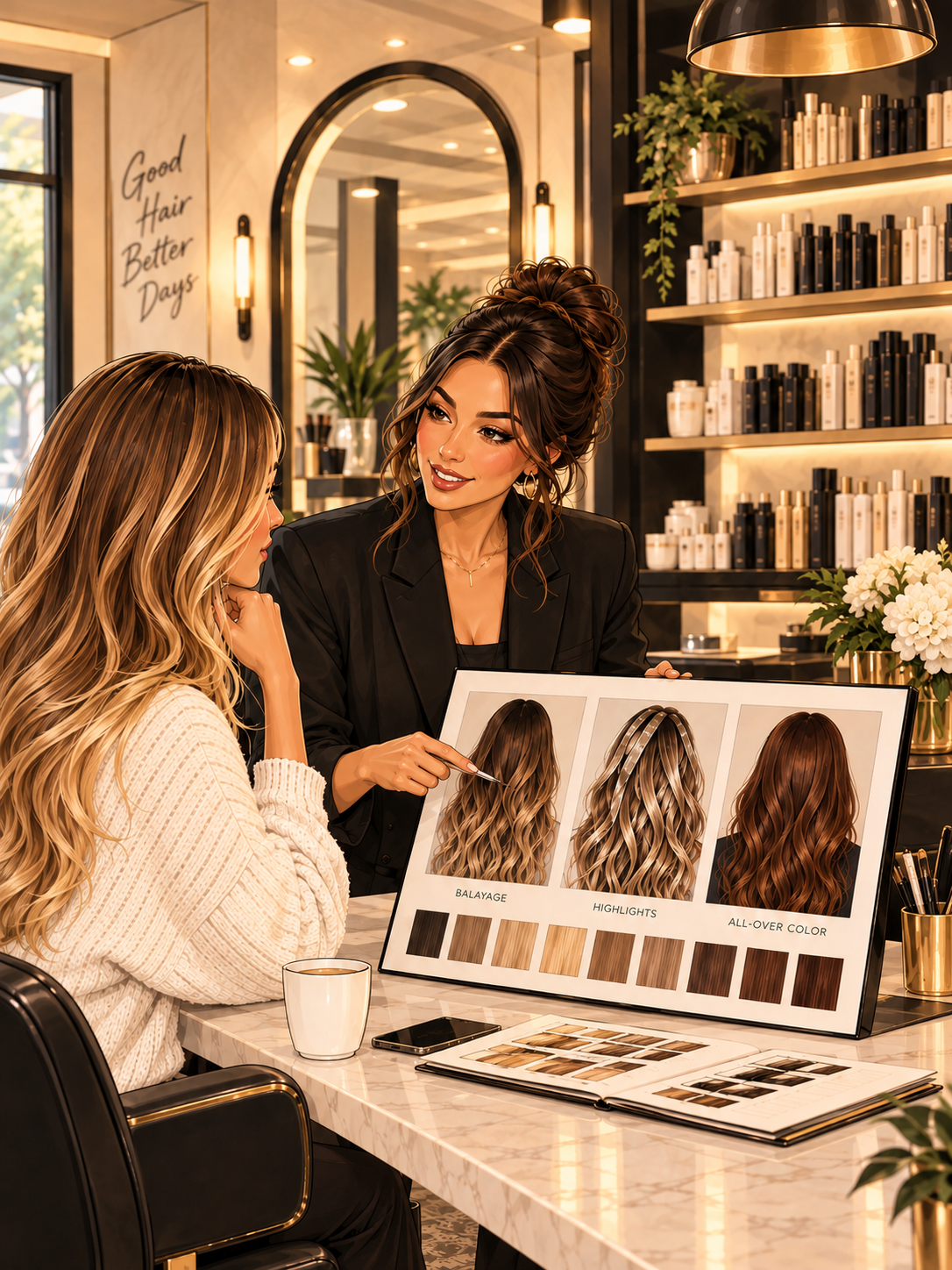
Balayage, highlights, lived-in color, gloss, and all-over color. If these terms sound familiar but you're not entirely sure what separates them, you're not alone. Hair-color terminology can be confusing, especially when social media uses several different words to describe looks that seem almost identical.
Understanding the basics can help you communicate what you want, ask better questions during a consultation, and choose a service that fits your hair and your lifestyle. The first thing to know is that some terms describe how color is applied, while others describe the finished look or a separate color service.
Balayage vs. Highlights: What's the Difference?
Balayage and highlights can both create lighter pieces and dimension, but they are not the same technique. The difference comes down largely to application, placement, and the visual effect your stylist is creating.
What Is Balayage?
Balayage is a freehand coloring technique in which a stylist paints lightener onto selected sections of hair. The placement can create a softer transition between the natural root area and the lighter lengths, with dimension that varies throughout the hair.
Balayage is often chosen for a sun-kissed appearance, blended brightness, or a more gradual-looking grow-out. It can work on different base colors and hair textures, but the final result depends on your starting color, previous color services, hair condition, and desired level of lightness.
One important distinction: balayage describes a technique, not one specific shade or finished hairstyle. It can create subtle brightness or a more noticeable change, depending on the placement and color plan.
What Are Highlights?
Highlights are selected sections of hair that are lightened or colored to create contrast against the surrounding hair. Traditional foil highlights involve placing selected sections in foils while the color or lightener processes.
Foils give a stylist control over sectioning and saturation. Depending on the placement, highlights can create brightness close to the roots, throughout the lengths, around the face, or across much of the head.
Highlights can be subtle or bold, fine or chunky, warm or cool. They are not limited to blondes. Highlights can add dimension to brunette, red, copper, and other hair colors, too.
So, is balayage better than highlights? Neither is automatically better. If you want a soft, painted effect, balayage may be worth discussing. If you want more consistent brightness through selected sections or closer to the root, foils may be a better fit. Many color plans combine techniques to achieve the desired result.
What Is All-Over Color?
All-over color generally means applying a color formula across the hair rather than focusing only on selected highlighted sections. Depending on the goal, it may be used to change the overall shade, refresh faded color, add richness, or create a more uniform appearance from roots to ends.
All-over color and highlights can also be combined. For example, someone might want a brunette base with a few lighter pieces for dimension. A stylist can plan the overall color and the highlights together so the result feels intentional rather than flat.
The phrase "all-over color" does not automatically mean permanent color, and it does not guarantee complete gray coverage. The product, formula, application, and goal all matter. If covering gray hair is important to you, mention that during your consultation.
Hair Color Terms You May Hear at the Salon
Once you start looking at color inspiration, you'll probably come across a few more terms. Here's what they generally mean.
Lowlights
Lowlights are deeper sections of color added among lighter or existing hair. They can restore contrast, add depth, or create a more dimensional result. Lowlights may be useful when hair looks very uniformly light and the goal is to bring some of the depth back.
Lived-In Color
Lived-in color describes a finished look designed to grow out softly, often with dimension and a less obvious line of demarcation at the roots. It may involve highlights, balayage, lowlights, root shading, gloss, or a combination of techniques.
Lived-in color is not one specific application method, and it does not mean no maintenance. You may be able to go longer between larger color appointments, but your preferred brightness, root contrast, tone, and hair growth can still influence when you want a refresh.
Root Smudge and Root Shadow
A root smudge or root shadow involves applying color around the root area to soften the transition between the roots and lighter lengths. The terms are sometimes used interchangeably, although the exact formula and placement can differ from stylist to stylist.
These techniques can help create a blended appearance and reduce a sharp contrast between the root area and highlights. They do not necessarily mean that the roots are being matched exactly to your natural color.
Toner
Toner is a term commonly used for a color formula that adjusts or refines the tone of hair. After lightening, a stylist may use a toner to create a cooler, warmer, more neutral, or otherwise customized shade.
Toner is not a substitute for every color service. It generally cannot take dark hair several levels lighter on its own, and it cannot guarantee that every unwanted shade will disappear. The result depends on the hair's existing level, underlying pigment, condition, and the formula used.
Gloss
A gloss is a color service or formula used to refresh or refine the appearance of hair color and often add shine. Depending on the product and formulation, it may enhance tone, adjust unwanted warmth, refresh faded lengths, or help blend the overall result.
Glosses vary, so the word does not always mean the same formula or outcome at every salon. At The Society Salon, our Gloss Refresh service is intended to add shine and keep color looking fresh between larger appointments. You can see it on our current color services menu.
Babylights and Face-Framing Highlights
Babylights are very fine highlights placed in small sections to create delicate brightness. Face-framing highlights focus on the hair around the face, where lighter pieces can draw attention to the front of a hairstyle.
These terms describe different aspects of a color plan. Babylights refer to the fine size of the sections, while face-framing describes where the brightness is placed. Either can be used alongside other techniques.
Which Hair Color Service Is Right for You?
The easiest way to narrow down your options is to think about the result you want rather than choosing a service name based on a trend.
- You want soft, blended brightness: Ask whether balayage or a combination of techniques could create the look.
- You want brightness closer to the roots: Discuss traditional foil highlights or a customized highlight placement.
- You want to change or refresh your overall shade: Ask whether all-over color, a root service, or a gloss is appropriate for your goal.
- You want more depth and contrast: Lowlights or a combination of light and dark pieces may be worth discussing.
- You want a softer grow-out: Ask about lived-in color and whether a root smudge or root shadow could help achieve the effect.
- You want to maintain your current blonde or brunette: A gloss or partial highlight may be enough, depending on what has changed since your last visit.
These are starting points, not rules. Your stylist may recommend a different combination after considering your current color, hair history, condition, and the amount of change you want.
Why Your Inspiration Photo Doesn't Tell the Whole Story
A photo can communicate the tone, brightness, placement, and overall feeling you like. But it cannot tell your stylist everything needed to recreate that result on your hair.
Your starting color, previous color treatments, existing highlights, hair condition, and maintenance preferences all affect the plan. Lighting, styling, and photo editing can also influence how a finished color appears in an image.
Bring the photos you like, and try to explain what catches your eye. Is it the brightness around the face? The contrast between light and dark pieces? The softer root? The overall shade? These details help your stylist understand your goal even if you don't know the technical term.
It's also worth discussing how often you want to return to the salon and how you prefer your color to look as it grows. Two people can choose a similar inspiration photo but need different techniques or maintenance plans to reach a result that works for them.
The Best Question to Ask Before Booking
Instead of asking only, "Should I book balayage or highlights?" try explaining what you want your hair to look like and how you want to maintain it.
You might say, "I'd like to be brighter around my face, keep some depth through the rest of my hair, and avoid a strong line as my roots grow." That gives your stylist a clearer starting point than a service name alone.
At The Society Salon in Melissa, Texas, our color services include balayage and foils, partial and full highlights, all-over color refreshes, gloss refreshes, and lived-in blonde or bronde options. If you're unsure what to book, our color services menu is a helpful place to start.
A color consultation can help you talk through your goals, current hair, maintenance preferences, and the options that may work for you. The right plan isn't necessarily the trendiest technique. It's the one that makes sense for your hair and the result you want to maintain.
The better you can describe your goal, the easier it is to plan your color together.