
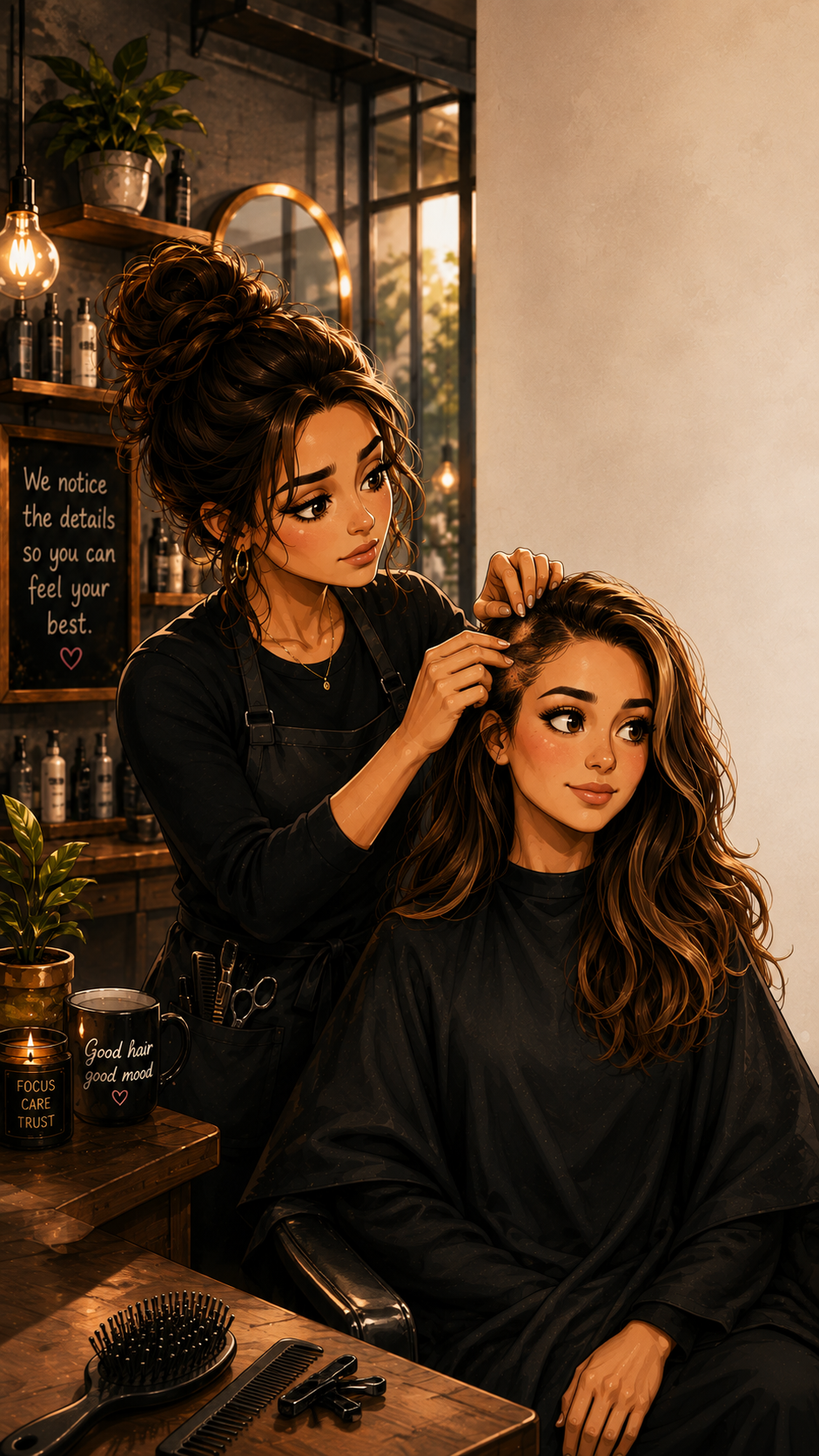
Most salon appointments are pretty straightforward. You sit down, catch up with your stylist, talk about your hair, and eventually leave feeling a little more put together than when you arrived.
But every once in a while, something happens in the chair that has nothing to do with color, extensions, or a haircut.
Recently, one of those moments happened at The Society Salon.
During a guest's appointment, one of our stylists noticed something on the guest's skin that did not look quite right. The stylist was not trying to diagnose it, and that is not a stylist's job. She simply noticed something unusual and felt it was worth mentioning.
So she did something simple. She told the guest what she had noticed and recommended that she have it checked by a doctor.
There was no diagnosis. No dramatic conclusion. Just a professional saying, "I noticed something here. You may want to have someone qualified take a look."
The guest listened.
Later, she returned to The Society and thanked the stylist for speaking up.
According to the guest, her doctor determined that the spot was skin cancer and told her that it was aggressive. During that medical visit, the doctor also discovered another spot that required attention.
We cannot know what would have happened if the stylist had never said anything. We also cannot know whether the guest would have noticed the spot herself or already had plans to see her doctor.
What we do know is that someone noticed something unusual and encouraged her to have it evaluated by a medical professional.
That is worth talking about.
We are sharing this story without identifying the guest or providing private medical details. The diagnosis came from her doctor, not from her stylist or The Society Salon.
The stylist simply noticed something that concerned her enough to say something.
And the guest took that suggestion seriously.
That's the part of this story that stays with us.
Hair professionals spend a lot of time looking closely at the scalp, hairline, ears, neck, and other areas that can be difficult for guests to see themselves. Parting hair, sectioning, coloring, cutting, and styling can naturally bring areas into view that might otherwise remain covered.
That does not make a hairstylist a medical professional. A stylist cannot determine whether a mole, spot, sore, discoloration, or other skin change is cancer.
But there is a difference between diagnosing something and noticing something.
If a stylist notices an area that looks unusual, mentioning it and encouraging the guest to ask a qualified healthcare professional about it can be a thoughtful thing to do.
The American Academy of Dermatology recommends paying attention to new or changing spots and seeking professional evaluation when something about a spot is concerning. Changes such as asymmetry, irregular borders, variations in color, growth, or evolution can be reasons to have a spot evaluated.
Those signs do not mean that a person has skin cancer. Many skin changes are not cancerous. They are simply reasons to let a qualified medical professional make that determination.
The same is true for something you may notice on your scalp.
The scalp can be easy to overlook when it is covered by hair. The American Academy of Dermatology recommends including the scalp when checking your skin and suggests using a mirror or asking someone for help when necessary.
You do not need to become an expert in identifying skin cancer. You simply need to pay attention to changes and know when it makes sense to ask a healthcare professional for an opinion.
And if your hairstylist ever mentions that they have noticed something unusual, try not to panic.
It does not mean they know what it is.
It may simply mean they saw something you had not noticed and thought it would be worth having checked.
In this guest's case, that simple conversation turned out to be incredibly important.
There is something else about this story that we appreciate.
The guest came back.
She did not have to return to the salon and tell the stylist what happened. She could have simply gone on with her life after seeing her doctor. Instead, she came back to say thank you.
For the stylist, that had to be a meaningful moment.
For all of us at The Society, it was a reminder of something we sometimes forget about the work we do.
A salon is a place where people come to take care of themselves. Yes, that often means hair. It means color, cuts, extensions, styling, and all the other things that make someone feel more like themselves when they walk out the door.
But it also means relationships.
It means conversations.
It means paying attention.
And sometimes, it means caring enough to say something when you notice that something seems a little off.
We are grateful that this guest listened to her stylist.
We are grateful that she followed up with her doctor.
And we are grateful that she came back and shared her story with us.
Her experience is also a useful reminder for all of us. If you notice a new, changing, unusual, bleeding, itching, or otherwise concerning spot on your skin, including areas that are difficult to see such as the scalp, do not try to diagnose it yourself.
Have it evaluated by a qualified healthcare professional.
Your hairstylist cannot tell you what a spot is. Neither can a photograph on the internet. But a medical professional can examine it and determine what, if anything, needs to happen next.
Sometimes paying attention is enough to start an important conversation.
And sometimes, that conversation may matter far beyond the appointment in the salon chair.